
What does a fractional COO actually do?
The term gets used loosely. Some people mean a part-time operations manager. Some mean a business coach with a grander title. Here is what the role actually involves, and what separates it from every adjacent thing it gets confused with.
- A fractional COO installs and governs operational structure in a founder-led business, part-time and embedded
- The role is active, not advisory: inside the leadership layer, not observing from outside it
- Core work: leadership cadence, financial visibility, KPI governance, accountability, and leadership development
- Different from a consultant who recommends, a coach who develops individuals, and an operations manager who works within existing structure
- Typical engagement: one to three days a week, six to eighteen months
The short answer
A fractional COO makes a founder-led business operationally functional: part-time, embedded inside the leadership layer, working across the whole operational picture rather than any single function.
“Fractional” means part-time. “COO” means Chief Operating Officer, the person responsible for how the business runs day to day, as distinct from the founder who sets direction and owns the commercial relationships. In a fractional model, that operational leadership comes at a fraction of the cost of a full-time hire, applied at the depth the business needs now. For the full picture, see what a fractional COO costs.
What it looks like in practice depends on the business. The core work is consistent: install structure, enforce accountability, build financial visibility, develop the leadership team, and free the founder to lead rather than manage.
The six things a fractional COO does
1. Installs and runs the leadership operating rhythm
Most founder-led businesses in the £500k to £5M range have no functioning leadership cadence. There are ad hoc meetings and reactive conversations when something breaks, but no consistent rhythm for reviewing performance, making decisions, setting priorities, and following through.
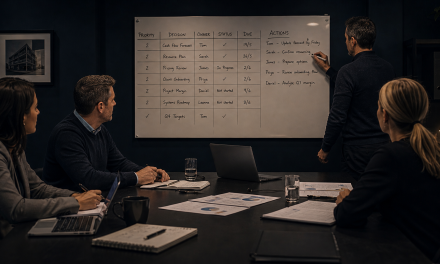
The fractional COO installs that rhythm and holds it: a weekly leadership meeting with a defined agenda, decision-focused, with clear outputs and a record of what was agreed; quarterly priority-setting that connects activity to the business’s goals; and a culture where preparation and follow-through are treated as non-negotiable. Most teams resist the discipline until they feel the clarity it produces, then cannot imagine working without it.
2. Builds forward financial visibility
Most founder-led businesses manage cash reactively. The balance gets checked when anxiety rises. Hiring, investment, and capacity decisions get made on instinct. Reporting, where it exists, tells you what happened last month rather than what happens in the next 30, 60, or 90 days.
A fractional COO installs a rolling cash flow model that shows the forward position at defined intervals, updated and reviewed at the leadership meeting, in a format that enables decisions rather than just records history.
The test: can you state with confidence what your cash position will be in 30 days? In 90? If not, you are making decisions without the information they require.
3. Governs KPIs and holds accountability
Most businesses have metrics. Few use them to govern behaviour. KPIs get defined, reported once or twice, then drift into the background as urgency takes over.
A fractional COO makes the performance dashboard functional: the leading indicators that actually predict performance, not just revenue and profit but utilisation, pipeline conversion, collections rate, capacity versus demand. The dashboard is reviewed every meeting and deviations are treated as decisions, not observations. And leaders are held to the numbers they own, which means the direct conversations about performance that most teams avoid. It is the most valuable and most underrated part of the role: a culture where commitments are kept is the foundation of a business that can scale.
4. Resolves structural problems that block progress
Every founder-led business carries a list of operational problems that have been identified, discussed, and never resolved. A fractional COO works through them systematically, not by doing everything personally, but by giving each a clear owner, a resolution path, and an enforced deadline.
- No single source of truth, with information fragmented across email, spreadsheets, and memory
- Unclear ownership, where several people are partly responsible and nobody is fully responsible
- Decisions routing to the founder that should be resolved at the leadership-team level
- Collections and billing managed reactively rather than as a standing discipline
- Tools used inconsistently because nobody governed the adoption
- Recurring failures resolved each time they occur rather than eliminated at source
5. Develops the leadership team
Structural problems are rarely purely structural. Behind most operational failures are leaders who are unclear on their authority, avoiding difficult conversations, or working below their potential because nobody has held them to a higher standard. A fractional COO develops them under live conditions, not as a traditional coach but as a direct operational colleague who models, challenges, and stretches them. The goal is a leadership team that sustains the discipline without the fractional COO in the room, which is the definition of a successful engagement. If you are weighing whether this is what your business needs, the founder’s honest assessment is a useful starting point.
6. Positions technology and AI in the operating model
Technology decisions in founder-led businesses are often made reactively: a tool gets adopted because someone recommends it, with no view of how it fits the operating model. The result is disconnected tools, inconsistent adoption, and overhead the technology was supposed to remove. A fractional COO treats technology and AI as a governance question. What does the business actually need? Where is a tool creating friction rather than removing it? What AI is relevant to this operational context now, and what is noise? Those decisions belong inside the operating-model review, not as separate technology projects.
What a typical week looks like
The specifics vary, but a week in an active retainer at two days a week looks roughly like this.
Monday, remote half day
Review the weekly dashboard ahead of the leadership meeting, flag KPI deviations, and follow up on actions where commitments slipped.
Tuesday, on site
Leadership meeting: performance dashboard, issues, priorities, decisions logged. Individual sessions with one or two leaders. A working session with the founder on decisions with operational implications.
Thursday, remote half day
Progress check on active structural projects. Financial review: cash flow update, collections status, any decisions the numbers trigger. Preparation for the week ahead.
This is illustrative, not prescriptive. Early months are more intensive as foundations are built; it lightens once the rhythm holds. See the Fractional COO service, or Founder Operational Advisory if a lighter-touch, time-limited intervention fits better.
How it differs from everything it gets confused with
vs Consultant
- Consultant diagnoses and recommends; fractional COO implements and governs
- Consultant ends at delivery; fractional COO stays until the structure holds
- Consultant works from outside; fractional COO works inside the leadership layer
vs Business Coach
- Coach works at the individual level; fractional COO at the organisational level
- Coach develops how a person thinks; fractional COO designs how the business runs
- Coach supports the founder; fractional COO develops the whole leadership team
vs Operations Manager
- Ops manager works within the structure; fractional COO designs the structure
- Ops manager executes processes; fractional COO governs the operating model
- Ops manager reports to leadership; fractional COO is part of leadership
vs Full-Time COO
- Full-time is five days a week, permanent; fractional is one to three days, time-limited
- Full-time costs £150,000–£250,000+ in year one; fractional is £6,500–£11,500/month with no on-costs
- Full-time suits significant scale; fractional suits £500k–£5M businesses
For the operations-manager comparison in full, see Fractional COO vs Operations Manager.
What a fractional COO is not
Being clear on this matters as much as the rest. A fractional COO is not responsible for commercial strategy; that belongs to the founder. They create the operational conditions for strategy to be executed, but do not set the direction. They are not a functional specialist standing in for the finance director or head of marketing; they govern across functions rather than replace expertise within one. And they are not permanent. The engagement has an arc: install structure, build leadership capacity, make the business self-sustaining, exit cleanly.
The measure of a successful engagement is not how indispensable the operator becomes. It is how quickly the business learns to run without them.
What it looks like in practice
A values-driven professional services firm, strong client relationships and recurring revenue, had an underdeveloped operational picture beneath it: retrospective reporting, reactive cash management, inconsistent collections, a leadership team naming problems without implementing solutions, and rising stress as complexity outpaced structure. The full detail is in the case studies.
We installed a weekly leadership cadence, 30 to 90 day forward cash flow visibility, disciplined collections with targets and rhythm, clear role ownership, and direct work with individual leaders on authority. Collections rose from 79% to 92% as a governed rhythm replaced inconsistent manual follow-through, and leadership anxiety dropped as visibility replaced assumption.
We love working with David. It may end up being the most impactful decision we have made in our business.Partner, professional services firm
Frequently asked questions
What does a fractional COO do?
A fractional COO installs and governs operational structure in a founder-led business, part-time. Day to day that means running the leadership cadence, holding leaders accountable to agreed priorities, reviewing financial and operational KPIs, resolving the structural problems slowing the business down, and developing the team’s capacity to run without founder dependency. The role is embedded, not advisory from outside.
How is a fractional COO different from a consultant?
A consultant diagnoses problems and delivers recommendations. A fractional COO implements solutions and governs their execution. A consultant’s engagement ends at the report; a fractional COO’s continues until the structure holds. If you need someone to tell you what to fix, that is a consultant. If you need someone to fix it and keep it fixed, that is a fractional COO.
How is a fractional COO different from an operations manager?
An operations manager works within an existing structure. A fractional COO designs and governs the structure itself. If the business lacks a coherent operating model, hiring an operations manager first puts someone in charge of a system that does not yet exist. The fractional COO builds the system; the operations manager runs it.
How many days a week does a fractional COO work?
Usually one to three days a week of embedded presence, depending on the complexity of the business and the depth of structural work. Advisory-level engagements can be lighter. You are paying for senior operational expertise at the level the business needs now, without the overhead of a full-time hire.
How long does an engagement last?
Advisory engagements, focused on design and installation, run three to six months. Fractional COO retainers, where ongoing governance is needed, run six to eighteen months. The engagement ends when the leadership team can sustain the structure without support, or when the business has grown enough to justify a full-time hire.
Related: for part-time operational support one level below the executive layer, see fractional operations manager — what the role covers, what it costs, and when it is enough.
Not sure this is what your business needs?
The Operational Clarity Call is a 30-minute structural assessment, not a sales conversation. You leave with a direct read on where your operational gaps are and what the right intervention is, whether that is a fractional COO, advisory, or something else.
Book an Operational Clarity Call