Built from inside growing businesses.
I am a fractional COO. I work with founder-led businesses at the point where growth has outrun the way the business is run: installing operating structure, developing the leadership team to hold it, and positioning technology deliberately rather than adding it and hoping.
A systems designer, not a report-and-leave consultant
Most advisory either diagnoses and departs, or embeds and never leaves. Purpose In Action does neither. It designs operating infrastructure and develops the leadership team to hold it, so the business becomes structurally independent of its founder, and the improvement stays after the work ends.
How David works
Structure first
Operating infrastructure installed across the four pillars of the Firm Foundation Framework, in sequence.
People to hold it
Leaders developed on authority, standards and difficult conversations, so the structure is owned rather than imposed.
Technology, deliberately
Technology and AI positioned inside the operating model, not bolted on.
Ownership handed back
The aim is structural independence: the founder freed from being the single point of failure.
Often the answer is a person already inside the firm: I develop trusted people into bigger roles, with the decision rights and visibility to carry them, so authority can widen beyond the founder safely.

I work with founders at the point where the business has outgrown the way it is run. The job is to redesign the system so it no longer depends on any one person to hold it together.David Schofield · Purpose In Action
Who you work with
David leads every engagement and every leadership meeting himself. Lukas Krondorf leads business development: he is often the first person a founder speaks to, and he runs the commercial side of an engagement once it starts.
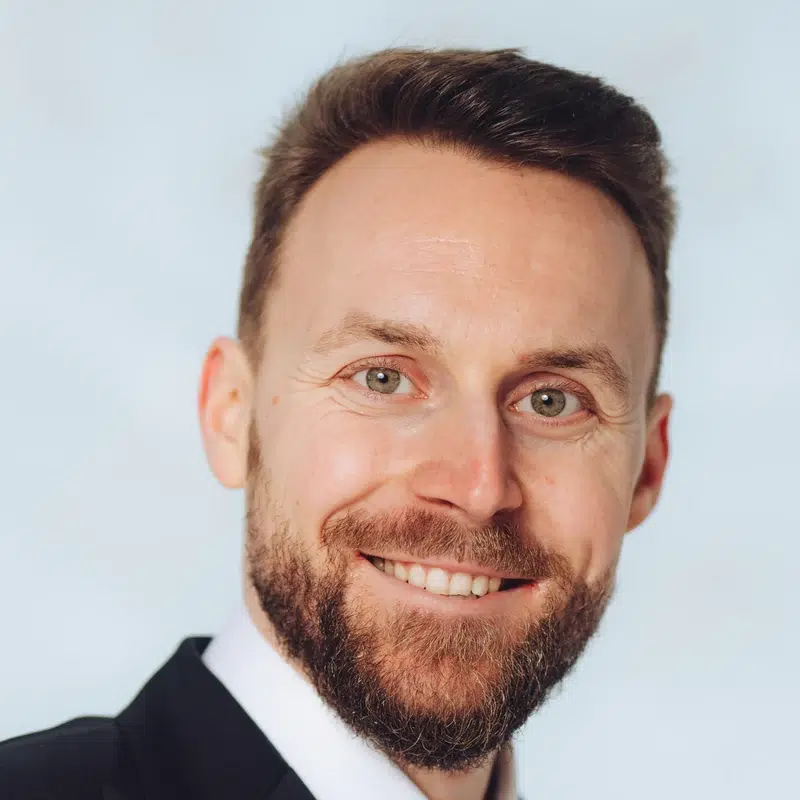
Lukas Krondorf · Business Development
Lukas joined a health-technology start-up in 2019 as its sixth employee and stayed through its growth past fifty people. He built the customer support function from scratch and laid the groundwork for the customer success team he went on to lead.
He also worked commercially with research customers, negotiating contracts worth several million Norwegian kroner, and led the operational side of the company's first international market entry, coordinating a fifteen-person team and an overseas partner. Today he runs its international research segment end to end: sales targets, pipeline, contract negotiation and customer requirements.
Before that he co-founded Enry, an early-stage digital health venture, so he has built a business from the founder's side as well. He is German, lives in Norway, holds a master's degree in exercise physiology and trained as a physiotherapist.
Proven outcomes
Range is the advantage
Since 2006 I have worked across industries, roles and businesses of my own. The hardest operational problems rarely sit inside one function or one sector. They live at the seams between them, which is where I have spent most of my working life.
Across functions
Operations and leadership, technology and finance: the whole operating system rather than one corner of it.
Across sectors
Professional services and law through to digital agencies and construction, with pattern recognition that transfers between them.
Built for the AI shift
As AI reshapes how every business runs, the edge moves from narrow specialism to the judgement to see the whole system and decide what actually matters.
Where this was learned
Not in a consultancy. In the businesses themselves: a steel plant, a family firm, a charity going through a funding cliff, and ventures of my own.
- 2006: Business analyst, Corus Steel, Port Talbot. A placement year inside a steelworks, learning the analysis methodology that still underpins how I map an operating model before changing it.
- 2009–2013: Caratrade. A four-person family business trading static caravans, around £500k turnover. I ran everything between the deals and the accounts: marketing, finance, sourcing, administration. Small enough that every operational decision showed its consequence within the week.
- 2012–2014: The Local Veg Box CIC. A community interest company of my own in South Manchester, delivering locally sourced seasonal produce. The first time I designed an organisation rather than working inside one.
- 2013–2014: Office manager, Action for Sustainable Living. An environmental charity of roughly fifteen staff and several hundred volunteers, reaching the end of a ten-year, multi-million-pound funding cycle that was not renewed. I led the operational side of the downsizing to around three staff and home working: IT, HR, facilities and the office move. The clearest lesson of my career in what structure survives under pressure and what does not.
- 2015–2018: Ethical Organiser. My own advisory practice: systems, accounts, websites, whatever made a small business work better. The predecessor to Purpose In Action.
- 2018 to now: Purpose In Action. Fractional COO work with founder-led businesses between £500k and £15M: legal practices, digital agencies, construction and professional services, in the UK and US. Engagements typically run six to eighteen months, one to three days a week inside the leadership team. Clients include Auxilium Software in London; most are confidential.
Alongside that: an MSc in Business Management (Merit, Manchester Metropolitan University) and a BSc in Business Information Systems (Sheffield Hallam). The MSc dissertation was on leadership in voluntary organisations, where people can always leave, so compliance is not available to you and only genuine reason works. That has turned out to be the more useful qualification.
Why I work with law firms
I am not a legal specialist, and law firms are not all I do. The legal work arrived through a referral, it suited me, and I have stayed with it for a reason worth stating plainly.
A sound judiciary is one of the things a society most depends on and most easily neglects. Legal work done properly (carefully, with integrity, by people who take the obligation seriously) matters more than most of what businesses produce. When a firm doing that work is held back by its own operating model rather than by the quality of its lawyering, that is a solvable problem. Solving it means more of the work gets done.
The patterns transfer in both directions. Lock-up, realisation and collections discipline are the legal profession's version of a problem I first met in construction and agency work: revenue earned but not yet cash, and no-one whose job it is to close the gap.
Based in the East Midlands, working UK & US
Based in Lubenham, Leicestershire, working with founder-led businesses across the United Kingdom and United States, in professional services, legal practices, digital agencies, consultancies and construction.
Media and commentary
David Schofield is available for comment on law firm operations and profitability, operational structure in founder-led businesses, and the fractional COO model. Published reference data: UK law firm financial benchmarks: utilization, realization, collection, lock-up and overhead, with sources and jurisdictions labelled.
Based in Lubenham, Leicestershire. Engagements across the UK and US. Enquiries via the contact page.
Away from the work
I live in the Leicestershire countryside with my family, a dog, and a rotating population of birds we have ended up looking after, most recently a crow, and pigeons before that. I train and teach martial arts, which is where I learned most of what I know about standards, and about how long it takes to make something automatic. There is usually music on.
I also built PurposeOS, a personal operating system for vision, goals and finances, the same structural thinking applied to a life rather than a business. It started as a tool for me.
Begin with a conversation
A focused 45-minute Operational Clarity Call, which is a direct read of where the business stands. No obligation.
Book an Operational Clarity Call →