Operational Excellence | The Foundation of Sustainable Growth
Growth without control becomes chaos. Businesses scale fast, chasing revenue and market share, then buckle under inefficiency, misaligned teams, and constant firefighting. The growth was real. The structure to carry it was not.
Sustainable growth comes from operational excellence: the operating discipline that lets a business grow without fracturing. It is the design that holds when pressure rises, and it has nothing to do with bureaucracy or with squeezing people harder.
What Operational Excellence Actually Means
Operational excellence is more than running efficiently. It is clear structure, a stable operating rhythm, and explicit accountability working together. In practice that means:
- Processes that are clear, repeatable, and able to scale.
- Defined roles with visible ownership.
- Leaders who can see the business through real operating metrics, not guesswork.
- Decisions made ahead of time, not in reaction.
None of it is about effort. It is about designing the workflows, rhythms, and systems that cut waste and free attention for the work that actually creates value.
Why It Decides Whether Growth Holds
Without operating discipline, growth multiplies the instability. With it, growth compounds what the business can do.
- Clarity reduces waste. When work is unclear, teams duplicate effort, drop handovers, and drift. Clear roles and processes reclaim the time and the money.
- Visibility creates control. You cannot steer what you cannot see. A tight set of operating metrics, reviewed weekly, surfaces risk early enough to handle it cleanly.
- Consistency builds trust. Clients return when delivery is predictable. People stay when expectations are coherent.
- Capacity enables scale. When the machine runs without you holding it together, your attention moves to strategy and growth instead of firefighting.
This sits on the same principle as Systems Are Freedom: the structure is what gives you room.
The Cost of Ignoring It
When operational excellence is missing, growth turns into drift. Firefighting replaces planning. Bottlenecks form around one or two key people, usually the founder. Morale drops as good staff carry the load of a system that was never built. Opportunities pass while the organisation is busy repairing yesterday. This is why so many businesses plateau: the foundation cannot carry the next level of complexity. You will recognise the pattern in The Silent Cost of Chaos.
What Installing It Looks Like
Operational excellence is not one framework bought off the shelf. It is a set of fundamentals installed in the right order.
- Audit reality. Find the bottlenecks, the decision noise, and the points where execution breaks.
- Clarify accountability. Name owners for functions and outcomes, not tasks in a vacuum.
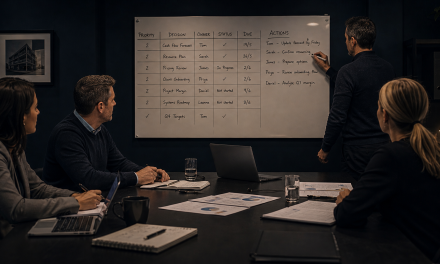
- Install an operating rhythm. A weekly review loop that keeps small problems small before they compound.
- Build a minimal tracker. Five to twelve leading indicators reviewed weekly, not vanity reporting.
- Codify the core workflows. The few processes that repeat constantly should not live in one person’s memory.
The goal is not more process. It is stable execution that does not depend on any single person being present.
Where to Start This Week
You do not need a transformation programme to begin.
- Run a weekly operating review. Look at the numbers, the priorities, and the blockers, and work each obstacle to a clear decision before the meeting ends.
- Map three core processes. Start with onboarding, delivery, and billing. Keep them simple and visible.
- Build a real tracker. Five to twelve leading indicators, reviewed weekly. Revenue on its own is not a control system.
- Clarify ownership. Name owners for outcomes so work stops floating around the organisation.
These build momentum, but only if you hold them as a standing rhythm rather than a one-off push.
Final Thought
Operational excellence is not a nice-to-have. It is the difference between a business that scales and one that implodes under its own growth. If you want growth with control, start by installing the structure beneath it.
Installing that structure, and developing the team to hold it without you, is the operational work I do with founder-led businesses. The Operational Clarity Call is a 45-minute diagnostic of where to start.